
The Disruption You Weren’t Watching
Everyone was watching the wrong thing. When image generation and video synthesis started making headlines, the conversation centered almost exclusively on output quality. Could a machine generate a convincing image? Could it produce footage that looked “real”? The demonstrations were impressive, and the debates about authenticity followed immediately. But that’s not the disruption that actually matters for AI creative.
The real disruption is this: creative direction. The bottleneck that has governed production timelines, agency fees, and brand content output for decades can now be systematized, taught, and executed by anyone who can articulate a clear brief.
That is a paradigm shift. Not because it removes the need for human vision, but because it removes the heavy infrastructure that used to be the only way to execute it.
“The constraint was never the camera. It was the decision-making bottleneck.”
Understanding the Real Bottleneck in AI Creative Production
Ask anyone who has worked inside a creative agency or an in-house brand team. The thing that makes production slow is not the technical execution. It is the decisions.
What does the shot look like? What is the colour grade? What emotion should this scene carry? How does this cut speak to the next one? Is the pacing right for this audience? Does this feel on-brand?
These questions of creative direction have historically required a very specific kind of expertise to answer confidently. That expertise came from years of set experience, client work, and aesthetic education. It was expensive. It was scarce. And because it was scarce, it became a bottleneck.
Brands that could not afford senior creative direction settled for generic content. Indie brands made do with templates and stock footage. The quality gap between enterprise creative and small-brand creative was largely a gap in access to experienced directorial judgment.
Why Creative Direction Is Teachable (And Therefore Systematizable)
Here is what experienced creative directors actually do. They make fast, confident decisions based on a clear understanding of the brand’s intended feeling, the target audience’s emotional triggers, and established visual language principles.
That sounds abstract, but it is remarkably concrete in practice.
A creative director looking at a rough cut makes specific decisions. They might note that a colour palette reads corporate instead of premium. They might see the pacing is too fast for an aspirational product. They might catch a transition that breaks the emotional arc, or notice the voiceover rhythm is fighting the visual rhythm.
These are not instinctive judgments that only emerge from decades of experience. They are learned frameworks applied rapidly. And they can be:
- Documented as creative principles
- Encoded into structured creative briefs
- Executed by AI creative systems trained on premium visual production
- Refined through rapid iteration at near-zero cost
What used to take a seasoned director and a large production team can now be executed by someone who understands their brand deeply. They just need to articulate direction clearly and know how to work with tools built for cinematic output.
The expertise is not gone. It has been systematized.
“Creative direction is teachable. And once it’s teachable, it’s democratizable.”

What AI Creative Changes for Indie Brands
The implications for smaller and mid-market brands are profound.
Previously, producing content that looked and felt like it came from a premium brand required either a significant agency retainer or an in-house team built around a strong creative director. Both options were expensive and slow. Both options were inaccessible to the vast majority of indie brands competing in crowded markets.
AI creative production removes those barriers. This is true especially when paired with good creative direction, even if that direction comes from someone who learned the frameworks rather than absorbing them over fifteen years of set experience.
An indie skincare brand can now produce cinematic product films. A DTC fashion label can create campaign visuals that stand alongside those of luxury houses. A startup in a niche B2B space can generate brand content that projects authority and aesthetic precision without a six-figure production budget.
This is not a small change. This is a redistribution of creative power that fundamentally alters who can compete at a premium level.
Why This Should Terrify Agencies (And Why It Shouldn’t)
Traditional agencies have built their value proposition around two things: creative expertise and production capability. AI is rapidly commoditising the production capability side. At the same time, the creative expertise side, which is the directorial judgment, is becoming more accessible through systematisation.
The agencies that will struggle are those whose primary value was access. Access to talent, access to equipment, and access to production infrastructure are no longer scarce.
The agencies that will thrive are those whose value is irreducibly human. Strategic insight, cultural intelligence, relationship depth, and the ability to navigate complex brand ecosystems all require genuine human judgment.
The exciting version of this story for both agencies and brands is that AI creative tools handle the execution scaffolding. This frees human creativity to focus exclusively on what only humans can do.
AI That Generates vs. AI That Amplifies Direction
Not all tools are built the same, and this distinction matters enormously.
There is a category of tool that simply generates. You provide minimal input like a text prompt, a mood board, or a style reference, and the AI produces output based on its training data. The results can be impressive. They can also be generic, derivative, and misaligned with what your brand actually needs.
Then there is a different category: AI creative platforms that amplify direction. These tools are built to execute a human’s creative vision at scale. The quality ceiling is set by the clarity of the brief. The better the direction, the better the output. The technology does not replace the creative judgment. It executes it faster, at higher scale, and at lower cost.
The difference in output quality between these two approaches is dramatic. Brands and creators who understand this will produce work that is unmistakably superior to those who do not. They know how to provide direction that the system can amplify, rather than just feeding prompts and hoping for the best.
“The difference isn’t the AI. It’s the quality of direction the AI is given to amplify.”
The New AI Creative Production Stack
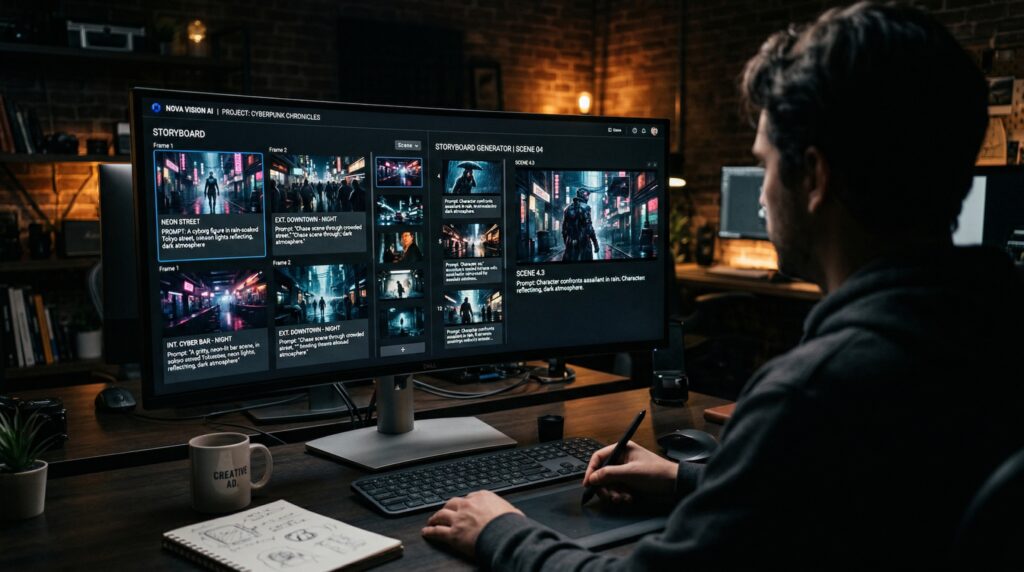
For brands and content teams building for this reality, the new production stack looks something like this:
- A clear, detailed creative brief that articulates brand feeling, target emotion, visual references, and strategic intent
- A set of defined brand visual principles that translate into AI-executable direction
- AI creative tools selected specifically for cinematic quality and directorial responsiveness
- A creative director, or a team member trained in directorial frameworks, who can iterate and refine output with precision
- A content pipeline built for volume: not one campaign, but continuous branded content at scale
This stack produces output that previously required a full agency engagement. It runs faster, costs less, and produces work that is visually indistinguishable from high-budget productions when the direction is good.
The Bottom Line
AI isn’t here to make creative directors redundant. It’s here to make the infrastructure that surrounded creative direction : the studios, the crew, the equipment, the post-production pipelines, the scheduling logistics, optional.
What remains essential is vision. Strategy. The ability to articulate what a brand should feel like and translate that into direction that a production system can execute.
Those skills are learnable. They are systematizable. And brands that invest in developing them rather than waiting for agencies to develop them on their behalf, will be operating at a speed and cost structure that permanently changes the competitive landscape.
The democratisation of production speed is not a future event. It’s happening now. Rivoq Labs exists at precisely this intersection: cinematic AI production, built on real creative direction, delivered at a pace that the traditional agency model never could have matched.
The question isn’t whether to build this capability. It’s how quickly you can get there.