
We are still figuring out what makes someone stop and actually watch an advertisement. This is our attempt to break down what separates creative that holds attention from the kind that gets scrolled past under a second.
The Gap Nobody Measures
There are advertisements people tolerate and advertisements people actually watch. The gap between those two things is where most creative budgets disappear. It’s worth being specific about what “worth watching” means. Not shared, not viral, not award-winning, just genuinely watched. Chosen, in the moment, over the option of leaving. That’s a lower bar than it sounds. The reasons are rarely about money. Some of the most-watched advertisements ever made were cheap. Some of the most forgettable ones cost millions. Budget determines what’s possible in production. It says almost nothing about whether an advertisement will hold someone’s attention once it starts.
What the Opening Frame Actually Does
The first few seconds of any advertisement are doing one thing: establishing whether it deserves the next few seconds. A great opening doesn’t need to be clever or unexpected. It needs to be right: the right tone, the right world, the right visual promise for what’s about to follow. When those things are in place, the viewer settles in without thinking about it. When they’re not, no amount of storytelling in the middle recovers what was lost in the first frame.
Why the Creative Does the Heavy Lifting
An advertisement can reach the right person at the right moment and still fail completely. Not because of targeting or timing, but because nothing in the creative gave that person a reason to stay.
This isn’t a niche observation. A 2023 study by NCSolutions, the Five Keys to Advertising Effectiveness, found that creative quality is responsible for 49% of incremental sales from advertising; more than reach, targeting, and recency combined. The advertisement itself is doing most of the work. Everything else just gets it in front of someone.
Craft Is Not the Aesthetic Layer
Pacing, composition, sound — these aren’t finishing touches. They’re decisions that determine whether an advertisement holds attention or loses it entirely. Pacing controls how much the viewer can process. Cut too fast and nothing lands. Hold too long and the mind wanders. The rhythm of an advertisement, where the cuts fall and how long a frame breathes, is doing emotional work at the same time as visual work.
Visual hierarchy decides what actually registers. When everything in a frame competes for attention equally, nothing gets remembered. Then there’s sound. Dual-coding theory shows that when audio and visual channels deliver complementary information, not the same information twice, retention improves significantly. When the voiceover simply describes what’s already on screen, one of the two channels is wasted.
Earned vs. Engineered
Emotion in advertising works when the audience sees something of themselves in it. Not because the ad is trying to make them feel something, but because it’s rooted in a human truth specific enough to feel real. The feeling is a byproduct of that truth, not the goal.
Cadbury’s “Kuch Meetha Ho Jaaye” has worked for years because it keeps finding ordinary moments people already know: a cricket match won, a small promotion, a quiet family celebration. Nothing dramatic. Just situations that feel lived in, with the brand sitting naturally inside them.
The difference between that and an advertisement that doesn’t connect emotionally isn’t always about production or budget. It’s about whether there was something genuine at the centre of it to begin with.

What the Brief Has to Answer
That genuineness doesn’t start on set. It starts at the brief.
Most briefs ask how to communicate a message. The more useful question is what the brand actually has the right to say and whether the answer to that is interesting enough to justify someone’s attention. One question leads to an advertisement that delivers information. The other leads to one that earns its place.
Getting that right at the brief stage is what determines everything that follows. The opening frame, the emotional honesty, the craft, none of it compensates for a brief that started from the wrong place.
What Every Medium Demands.
A print advertisement has one frame to do everything a video does across thirty seconds. No pacing, no sound, no second chance. Every decision: the image, the copy, the amount of white space, has to work harder because there’s nothing else to carry the weight. A billboard has roughly three seconds from someone moving past it. There’s no room for a second thought or a qualifying line. One image, one idea, or nothing. Digital advertising exists in an environment designed to pull attention in every direction at once. But what every medium ultimately demands is the same: one idea, specific enough to cut through whatever surrounds it, and true enough that the person on the other side feels it was made for them.
Beyond the Mechanics
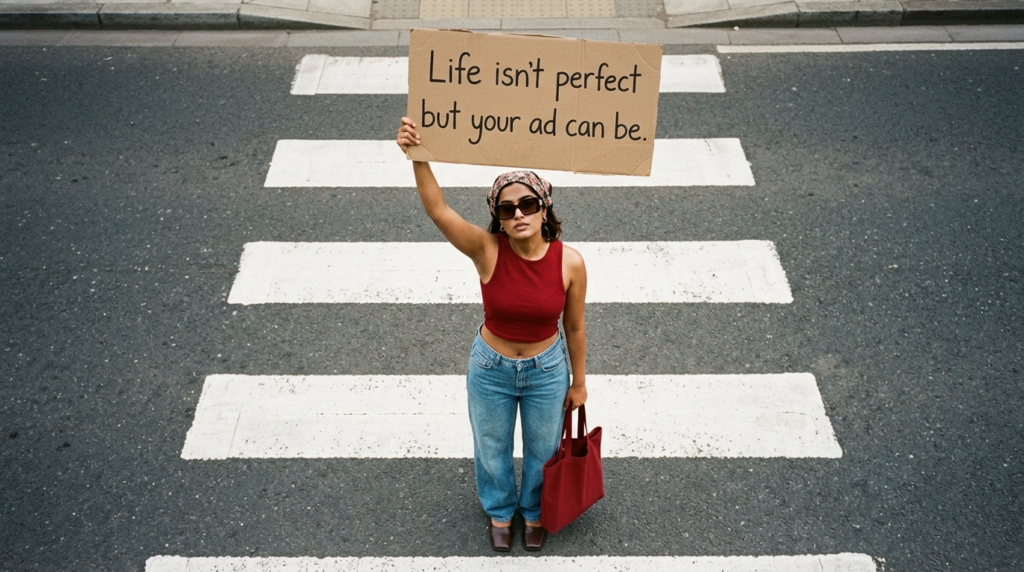
There’s a version of this conversation that reduces it to a checklist: hook in the first three seconds, clear message, strong visual. Those things matter. But they describe the mechanics of an advertisement, not the quality of one. Plenty of advertisements tick every box and still don’t hold anyone. What actually keeps a viewer watching is harder to systematise. An advertisement that feels considered holds differently from one that feels assembled. It shows up in the work and so does its absence.
The Role of Consistency
A single great advertisement is one thing. What it means for a brand over time is another. The advertisements people remember years later tend to come from brands that have been consistent, not in repeating the same creative, but in maintaining the same point of view across different executions.
The Amul girl has been commenting on current events since 1966. The campaign works not because any single execution is a masterpiece but because the voice has never wavered. Viewers know what to expect from it in terms of tone, and that familiarity creates a kind of trust that individual advertisements can’t build on their own. Consistency in advertising isn’t about repetition. It’s about a brand knowing what it stands for clearly enough that every advertisement it makes feels like it came from the same place even when the format, the platform, and the message are completely different.
Before the Skip Button
An advertisement that earns attention genuinely earns it, across any medium and any format, is always the result of the same thing. A brand that was honest enough about what it stands for, and disciplined enough to express that without compromise. That clarity is what makes a viewer stay for the next frame, a reader linger on a page, or someone remember an advertisement years after they saw it. It isn’t a formula. It’s a standard. And the brands that hold themselves to it consistently are the ones that build something that lasts beyond any single campaign.
Where Rivoq Comes In
At Rivoq Labs, this is precisely where the work begins. We don’t start by looking at what the technology can do; we start by looking at what the brand needs to say. Before the first line of a script is written, before a single frame is rendered, and long before any production decision is finalized, we engage in a process of deep creative interrogation. The fundamental question isn’t just about the message but about the mandate: what does this advertisement deserve to be about?
n a world of infinite, often hollow content, we believe that an advertisement must have something genuine at its core to survive the first second of a scroll. This ‘directed’ approach ensures that our use of AI is never arbitrary. Instead, it is a precision tool used to execute a vision that has already been meticulously defined. We define the feeling, the tone, and the visual promise first; the cinematic craft and technical execution follow as a natural, powerful consequence of that initial clarity.
Most advertisements ask to be watched. The ones worth watching don’t ask.