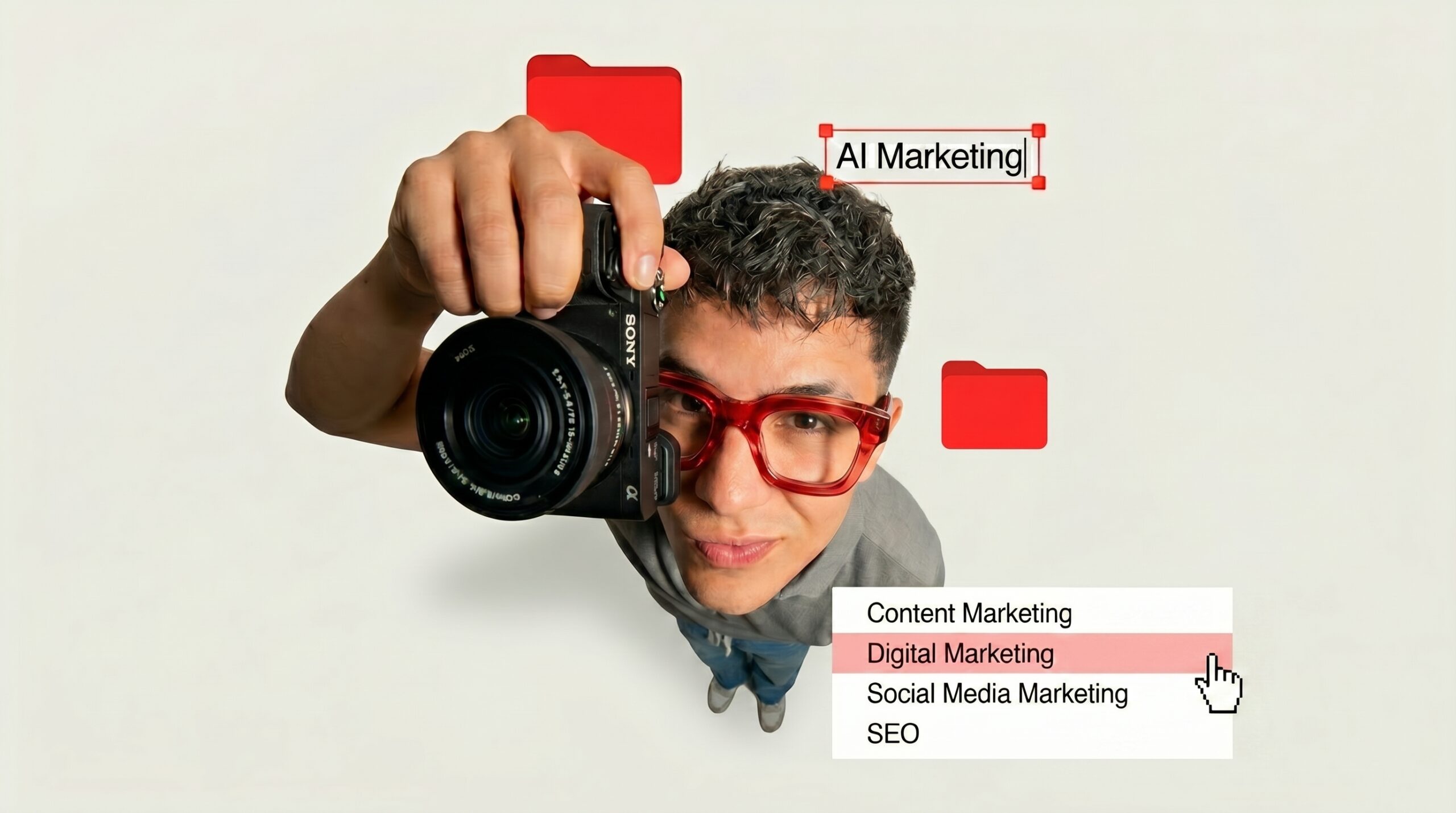
AI is changing how brands plan campaigns, write copy, and target audiences. This is a practical guide to where Digital Marketing with AI actually adds value in your marketing stack and where human judgment still leads.
Why Most Brands Are Thinking About AI the Wrong Way
Over the last two years, artificial intelligence has rapidly become one of the most talked-about shifts in marketing. Founders, marketing teams, and agencies alike have rushed to experiment with AI-generated copy, automated content calendars, ad creatives, chat assistants, analytics dashboards, and campaign optimization tools. For many businesses, especially smaller brands with limited resources, the promise has been compelling: faster execution, lower costs, and the ability to produce more content without dramatically increasing headcount.
But beneath the excitement lies a growing misconception.
Most brands are approaching AI as a shortcut to content production rather than as a redesign of how marketing itself works.
This distinction matters because the future of digital marketing is unlikely to be defined by whichever company produces the highest volume of content. Instead, the winners will likely be those that understand where intelligence compounds through automation and where human judgment remains irreplaceable.
The question, then, is no longer “How do we use digital marketing with AI?”. The more useful question, however, is “Which parts of marketing should become AI-powered, and which parts still require human thinking?” Because AI is not replacing digital marketing. It is un-bundling it.
Some parts of the marketing stack are becoming dramatically more scalable through automation. Others are becoming even more valuable precisely because machines cannot replicate them effectively. Understanding the difference is where most brands either gain advantage or waste time.
AI Is Changing Marketing, But Not All Parts Equally
One of the biggest mistakes brands make when adopting AI is treating marketing as a single activity.
Marketing is not one function. It is an ecosystem of decisions, systems, and creative judgment layered together. Campaign planning, audience targeting, messaging, visual identity, copywriting, performance optimization, storytelling, and brand positioning all operate differently.
AI affects each of these areas differently.
Some marketing activities benefit enormously from automation because they rely on repetition, pattern recognition, and scale. Others depend on taste, emotional nuance, cultural understanding, and strategic clarity, areas where human judgment continues to outperform.

The practical challenge for brands is understanding where to lean into AI and where to resist the temptation to automate too aggressively. The companies seeing the strongest outcomes from AI adoption are not replacing marketers. They are redesigning workflows.
Where Digital Marketing with AI Actually Adds Value in the Marketing Stack
The strongest starting point for most brands is campaign planning and research.
Traditionally, marketing planning required significant manual effort: competitor analysis, audience segmentation, trend mapping, content planning, keyword research, and market observation. AI dramatically accelerates this process. Teams can now analyze market conversations faster, identify emerging consumer patterns, summarize competitor activity, and generate campaign hypotheses in hours rather than weeks. This does not eliminate strategic thinking. It improves strategic speed.
This acceleration is not theoretical. According to McKinsey’s State of AI research, organizations embedding generative AI into core business workflows are already reporting measurable gains in productivity, speed, and operational efficiency, particularly in marketing and customer-facing functions. The implication is increasingly clear: AI creates the greatest value when it augments workflows rather than functioning as isolated experimentation.
Similarly, AI adds enormous value in copy ideation and creative iteration.
Ad copy, email variations, hooks, captions, product descriptions, landing page experimentation, and social media messaging can now be generated at an unprecedented scale. Instead of debating one headline, marketers can test twenty. Instead of launching a single ad concept, teams can experiment across multiple angles simultaneously. This is particularly valuable in performance marketing environments where small improvements in messaging can materially impact acquisition costs.
Audience targeting is also becoming increasingly AI-assisted.
Modern advertising platforms already rely heavily on machine learning to optimize delivery, identify patterns in consumer behaviour, and improve targeting precision. AI helps marketing teams identify which audience segments respond best, predict purchasing behaviour, and optimize spending efficiency more effectively than traditional manual methods.
The implication is significant. Many operational bottlenecks that historically slowed marketing execution are disappearing. Planning becomes faster, testing becomes cheaper and iterations become continuous. This fundamentally changes the economics of marketing.
The Temptation of Infinite Content
While AI is bringing around a tectonic shift, this is also where brands begin making costly mistakes. Just because AI makes production easier, many teams assume the solution is simply more content, posts, ads, campaigns and output. But volume alone rarely creates differentiation.
In fact, one of the unintended consequences of generative AI is the rapid emergence of generic marketing. Feeds are increasingly crowded with polished but emotionally forgettable content. Brands sound similar. Visuals converge. Messaging becomes interchangeable.
What disappears is perspective. Consumers do not remember brands because they posted frequently. They remember brands because they stood for something recognizable.
This is why production efficiency and brand effectiveness are not the same thing. While AI definitely increases the speed of execution, it does not automatically improve clarity.
Where Human Judgment Still Leads
Ironically, as AI improves, human judgment becomes more important, not less. There are certain dimensions of marketing where automation struggles because the challenge is not execution, rather it is interpretation.
Brand positioning is one of them. AI can generate hundreds of positioning statements, but it cannot decide what your company should ultimately stand for. It cannot determine the emotional territory your brand should own or the cultural meaning you want consumers to associate with your product.
Storytelling is another. AI can help generate scripts, edit footage, and scale content production, but it cannot fully replace narrative instinct. Strong storytelling depends on emotional timing, tension, aspiration, identity, and human meaning. Consumers rarely buy products rationally. They buy narratives about who they are, who they want to become, and what belonging feels like.

Creative judgment also remains profoundly human. Taste is difficult to automate. Knowing when an ad feels too polished, when messaging feels emotionally flat, or when a visual loses authenticity depends on intuition shaped by culture and experience.
This matters because creative quality continues to be one of the strongest drivers of advertising performance. Nielsen research consistently finds that creative execution remains among the largest contributors to campaign effectiveness, suggesting that while AI may accelerate production, the underlying quality of human judgment still materially influences outcomes.
This is particularly important because digital audiences have become increasingly sensitive to generic content. When everything starts looking equally optimized, differentiation often comes from a distinctly human perspective.
In many ways, AI makes good judgment more valuable because weak judgment becomes easier to scale.
The New Digital Marketing with AI Model: Human Strategy, AI Execution
The most effective approach to digital marketing today is not choosing between humans and AI. It is designing systems where both contribute differently. AI handles repetition, iteration, scale, testing, optimization, and production acceleration. Humans, on the other hand, focus on positioning, narrative, creative direction, emotional resonance, and strategic clarity.
This changes the role of marketers. The future marketer is less of a manual executor and more of a systems architect. Instead of producing every asset themselves, they design frameworks that guide how intelligence operates.
They define:
- what the brand stands for
- how content should feel
- what narratives remain consistent
- what emotional territory the brand owns
- where experimentation happens and where consistency matters
In this model, AI becomes an amplifier of strategy rather than a replacement for it.
How Brands Should Actually Get Started
For most businesses, starting digital marketing with AI does not require rebuilding the entire marketing stack overnight. The smartest approach is incremental.
Begin with operational layers first. Use AI to improve research, content ideation, ad testing, analytics interpretation, and production efficiency. Allow teams to experiment with workflows while measuring actual impact. Only then move toward more sophisticated applications such as campaign automation, creative systems, personalization, or predictive optimization.
Most importantly, avoid automating brand judgment too early. Consistency matters. Without strong positioning and narrative clarity, AI simply scales confusion faster.
Where Rivoq Fits In
At Rivoq Labs, we believe the future of digital marketing with AI belongs to brands that understand this balance.
AI is extraordinarily powerful when applied to the right layers of marketing. But technology alone rarely creates memorable brands. The real advantage comes from combining intelligent systems with strong creative direction. That means using AI where scale matters, while preserving human judgment where identity matters.
Our approach integrates AI-powered production, performance-driven iteration, narrative systems, and creative strategy into workflows designed not just to produce more content, but to produce smarter, more consistent brand growth. The landscape is continually changing for digital marketing with AI.
Campaign planning is becoming faster. Testing is becoming cheaper. Copywriting, targeting, and production are becoming dramatically more scalable. But while execution is changing, judgment still matters. The brands that succeed in the next era of marketing will not be the ones that automate everything. They will be the ones that understand where intelligence compounds and where humanity still leads.